Everyday life in Australia
Dangerous animals in Australia: what actually crossed our path in three months
The short version
- In three months we have seen 18 species ourselves, from a dolphin on arrival day to a goanna in our own garden.
- Three snakes, two of them since we moved into the rainforest. A green tree snake lives in the stone wall beside the pool. Not one encounter turned dangerous.
- According to the Australian Snakebite Project, a median of two people per year die of snakebite in Australia. Almost half of all bites happen because someone was near a snake without knowing.
- There are no saltwater crocodiles or cassowaries here, and you will look for a wombat in vain on this stretch of coast. All three live somewhere else.
- At the bottom you will find a list to tick off and print for your own time here.
“What about all those dangerous animals?” You hear that question a lot beforehand. Do you even see them in everyday life? And if you do, what is it actually like?
I can answer it now, but not the way people expect. We arrived in Byron Bay on 25 June. What has happened since then was less dramatic and considerably more beautiful than I had expected myself. And the one moment that genuinely mattered did not come from an animal at all. It came from a neighbour, and her story.
Our tally after three months
This is not a list of animals that exist in Australia. It is the list of animals we have seen with our own eyes, with dates, on the east coast between Byron Bay and the hinterland. Every stamped field stands for a day we stood there and watched.
Stamped means: seen ourselves. Not in a zoo, not on a tour, not on somebody else's phone.

The first encounters
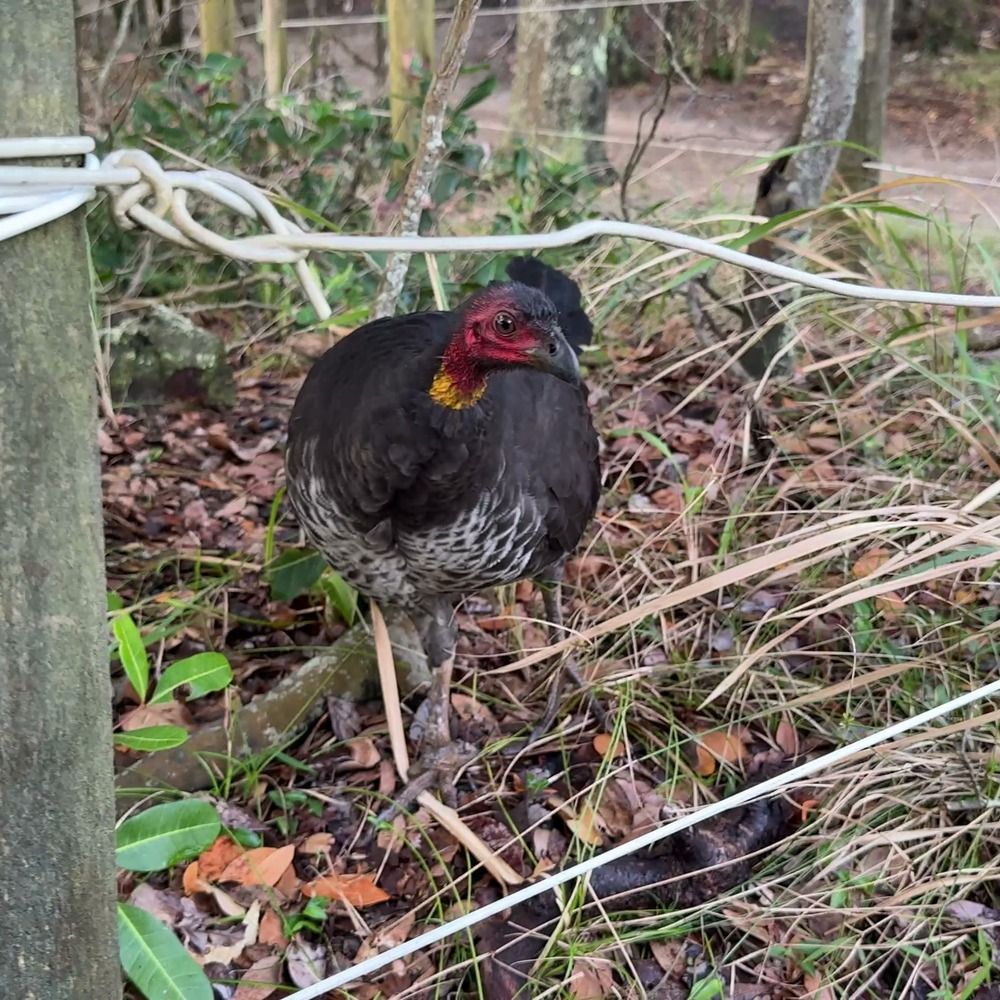
The first interesting animal was not a snake, not a spider and nothing out of the sea. On arrival day a dark, chicken-sized bird was walking along the fence beside the coastal path, scratching in the leaf litter. No kangaroo, no koala. A brush turkey. I like them. But keep an eye on your food at the beach. I have watched them get a zip-lock bag open and tear into a packet of chips.
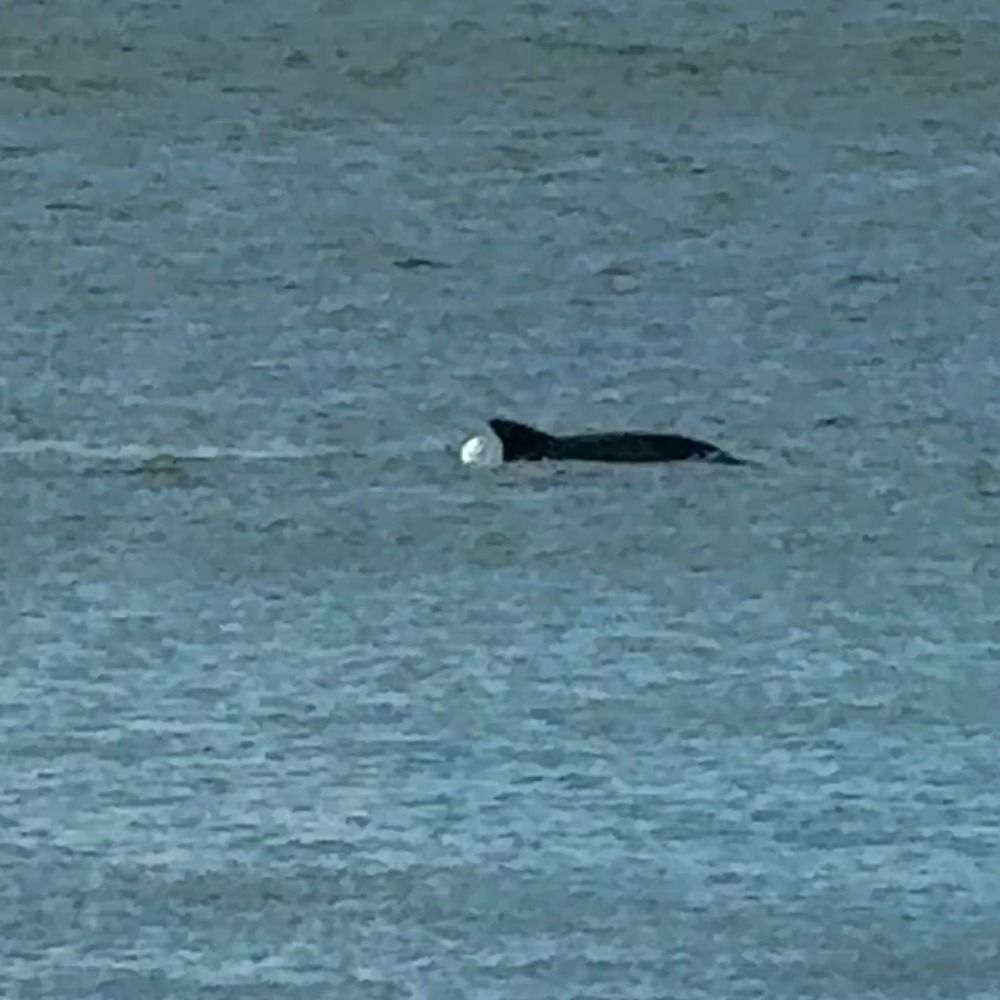
Later the same day, from the beach, a dorsal fin in the water. Dolphins, on day one. I had not counted on that.
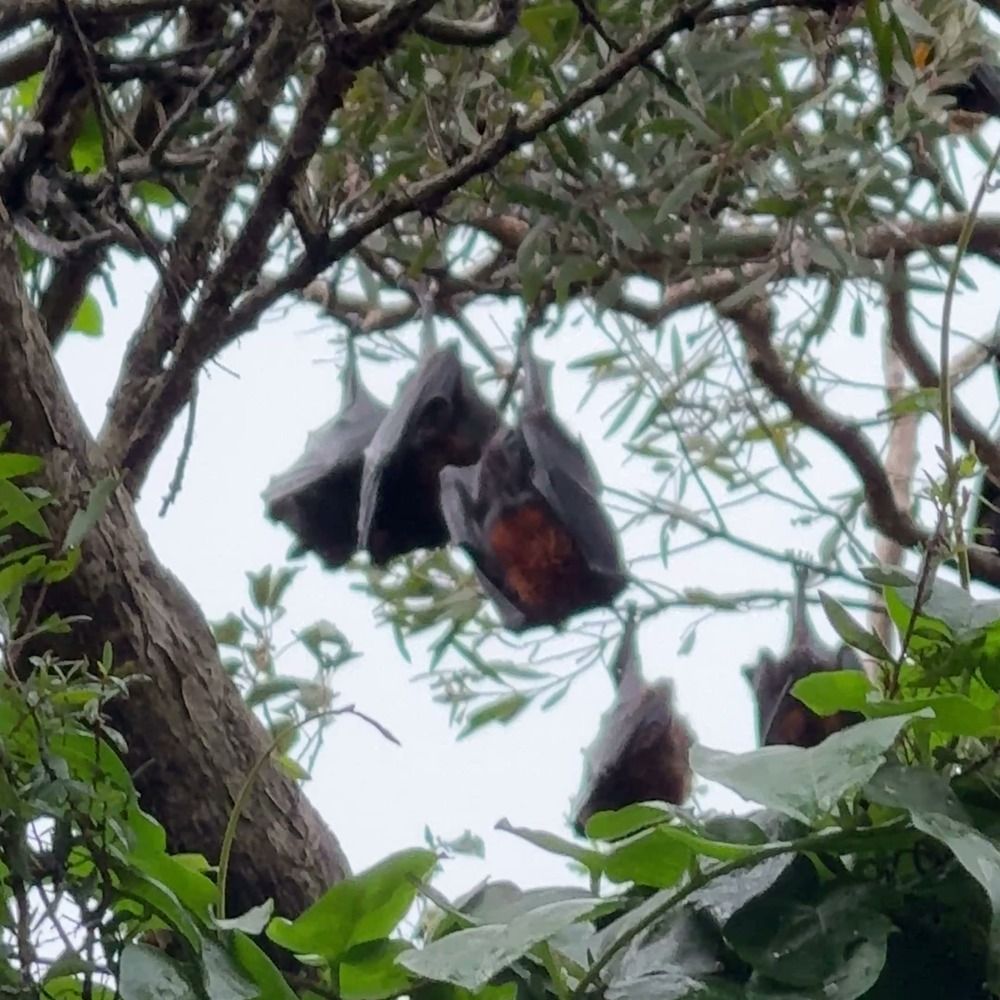
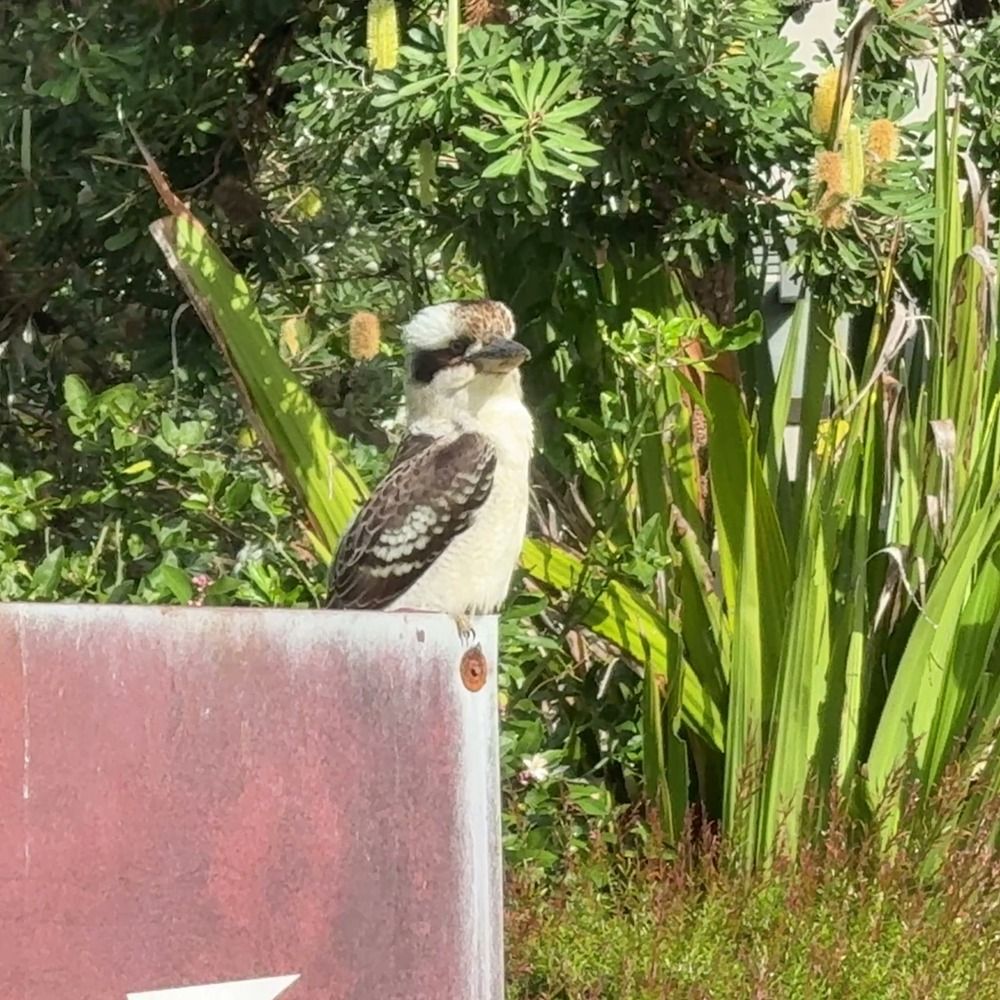
The next evening, flying foxes hung upside down in a tree, the leaves still wet from the rain. Three days later a kookaburra sat on a sign pointing to the beach and let itself be looked at in peace.
The first week
On 30 June an echidna rummaged through the leaf litter at the foot of a rotting trunk, so close that I did not want to move. In a photograph an animal like that looks like a ball of spines. You only see the difference once it moves.
I set out to jog. It turned into more standing still than running.
The fourth of July was the day both things happened. I ran up the Lighthouse Walk, and up ahead people were standing and looking upwards. There he sat, grey, in the fork of a branch. My first koala, after more than two years I had already spent in this country at an earlier time. A item on a list I did not know I was keeping.

Twenty minutes later, from the cliffs, a dark shape in the turquoise water. A shark, a big one, swimming in from the direction of the surfers. I let them know down below. Nobody seemed particularly bothered. I had been planning to surf myself that day and left it. My respect was a little larger than my plan.

Whales, and how to miss them
Cape Byron is the easternmost point of the Australian mainland, which puts it directly on the humpback migration route. Between May and November they pass along the east coast, heading north and later back south again with their calves.
On 3 July I was standing at the housesit and they went past outside, far enough away that you could only make them out by the spouts. On 26 July I set off with the drone to finally get decent footage. First it was too windy. Then the whales were too far out. Then I found dolphins instead of whales.

And then there were, closer than anything before. Later, when I was already back at the car, one swam past right next to the surfers at the bay where I usually surf. Earlier that same day I had filmed a koala. Some days hand you everything at once, after letting you walk for hours first.
The wallaby we had to wait for
On 3 July, the morning after my first night at the housesit, I said into the camera that wallabies were supposed to hop through this garden constantly. I had not seen a single one.
It took seventeen days. On 20 July, on a dirt track through the coastal heathland south of Byron Bay, one stood in the middle of the path and looked back at me. Then another, and another. Four days later, one in the evening light, standing upright in the tall grass.

The waiting is part of it. It is the better part, in fact.
That is exactly why this article ends with a list to tick off instead of a gallery. The appeal is not in having seen everything. It is in the empty fields.
Then on 29 July something was sitting on a rock at the edge of the path, upright and completely motionless, and let me look at it from two metres away. Rust-red chest, a jagged crest along the neck, a dark stripe through the eye. From everything I can find, an eastern water dragon. I am not certain, and that is the bridge to the next part.

Snakes: what the numbers say
On 23 July I was walking a shaded track through the coastal green and pushed my way through some scrub. Something small slid off the path into the grass in front of me. My first snake. To this day I do not know what it was. It was gone immediately, and there is no picture of it.
What occupied me more that day than the snake itself was a story somebody had told me shortly before.
The neighbour
A woman living at the housesit next door, where we spent our first weeks as a family, helped look after the dogs. She has not been able to work for years, for health reasons. The cause goes a long way back: she was bitten by a brown snake, one of the most venomous species here.
At the time she was living in a tipi with her children. She had to get up in the night, stood up, and in the dark she stepped on the snake right beside the mattress. Not in the bush. Not on a hike. Beside her own bed.
On the property where I was staying at the time, she said, there lived one brown snake and several pythons. They generally stayed in the scrub, she said. Once she had nearly stepped on one again.
So what do the numbers say?
In my video I said something like “maybe one death a year”. That was from memory. The solid source is the Australian Snakebite Project, a ten-year study run across Australian hospitals and published in the Medical Journal of Australia.
The part that surprised me most was not the death rate, though. It is the question of how people get bitten.
So almost half of all bites happen not because a snake attacks somebody, but because somebody was walking along and noticed nothing. In 52 per cent of cases the bite was to a leg. And 31 per cent happened near houses, with a further 14 per cent inside buildings.
Which makes my neighbour's story not an outlier. It makes it the standard case.
How to tell the dangerous ones apart
Honestly: reliably, you cannot. That is the most important sentence in this section. Even experienced people confuse species, and juveniles look different from adults. What you can learn is a rough distinction at a distance, nothing more.
What we taught the kids
- Stay on the path. Not into tall grass, no reaching into leaf litter.
- Closed shoes in the bush. More than half of all bites are to the leg.
- Stop instead of running. If there is a snake: halt, keep your distance, let it move away.
- Never touch, never shoo it off. Not even with a stick.
- Take a light at night. The neighbour's story happened in the dark, two steps from her bed.
Not medical advice. If a snakebite is suspected in Australia, call 000 immediately. The official first aid guidance is a pressure bandage with immobilisation, do not let the person walk, do not wash the wound and do not attempt to suck out venom. The current instructions are published by healthdirect Australia. We only pass on what we have learned ourselves.
Postscript: the rainforest
Everything up to here happened on the coast, during the first two months. At the end of August we moved, away from the ocean and into the hinterland. A property in the rainforest, pool, horse paddock, open veranda. I said at the time that everything was a bit more basic here. That is true. What I had not seen coming: the list that had grown steadily over two months almost fell over itself in the two weeks that followed.
The last days at the old address
It started small. On 21 August a small brown lizard sat on the brick wall next to the cushion on the veranda, early in the morning. Four days later a cane toad sat on the same concrete, fist-sized, entirely unimpressed. I carefully nudged it towards the grass with the broom handle. The kids watched intently, the way they always do.

The next day a huntsman sat on the pool net at the edge of the water. Palm-sized, flat, motionless. That evening a second cane toad in the grass by the roadside. I had gone six weeks without seeing any of them. Then three in two days.
Moving day already had a visitor
On 28 August we filled the car twice, an hour each way. Just after seven in the evening a gecko was sitting on the dark ceiling beam. Twenty minutes later it was on the fringed blanket on the sofa. First evening, first animal in the house, and honestly it was more funny than anything else.
3 September
Just after three in the afternoon something thin and green-brown moved through the grass at the foot of the stone wall and disappeared into the ferns beside the pool. We stood there and waited. A few minutes later it came back out across the red terrace tiles, entirely unhurried, and for the first time ever I had a snake on video. A green tree snake. Non-venomous.

That same night I almost stepped on a python. I did not notice a thing. I was walking along the path in the dark with Linnea on my arm, and behind me Lucy gave a start and called out "python". With the torch we then saw it, right beside the gravel path in front of a bush.
Pythons are harmless. Even so, it was a sign: in the dark especially, it pays to look at your surroundings properly.
And then it simply kept going
On 5 September Joris stood at the open door in the morning, pointing outside, excited. A goanna, down in the sloping garden. By the time I got there with the camera, only the bush was still moving. Counts as seen, I would argue. So, ticked off.
On 12 September, at night, a large flat spider on the white outside wall, lit by the lamp. On 13 September a small lizard ran across the breakfast table in the morning and stopped in the strip of sunlight between the peanut butter and the storage jars. You get used to it faster than you would think.
The small housemates
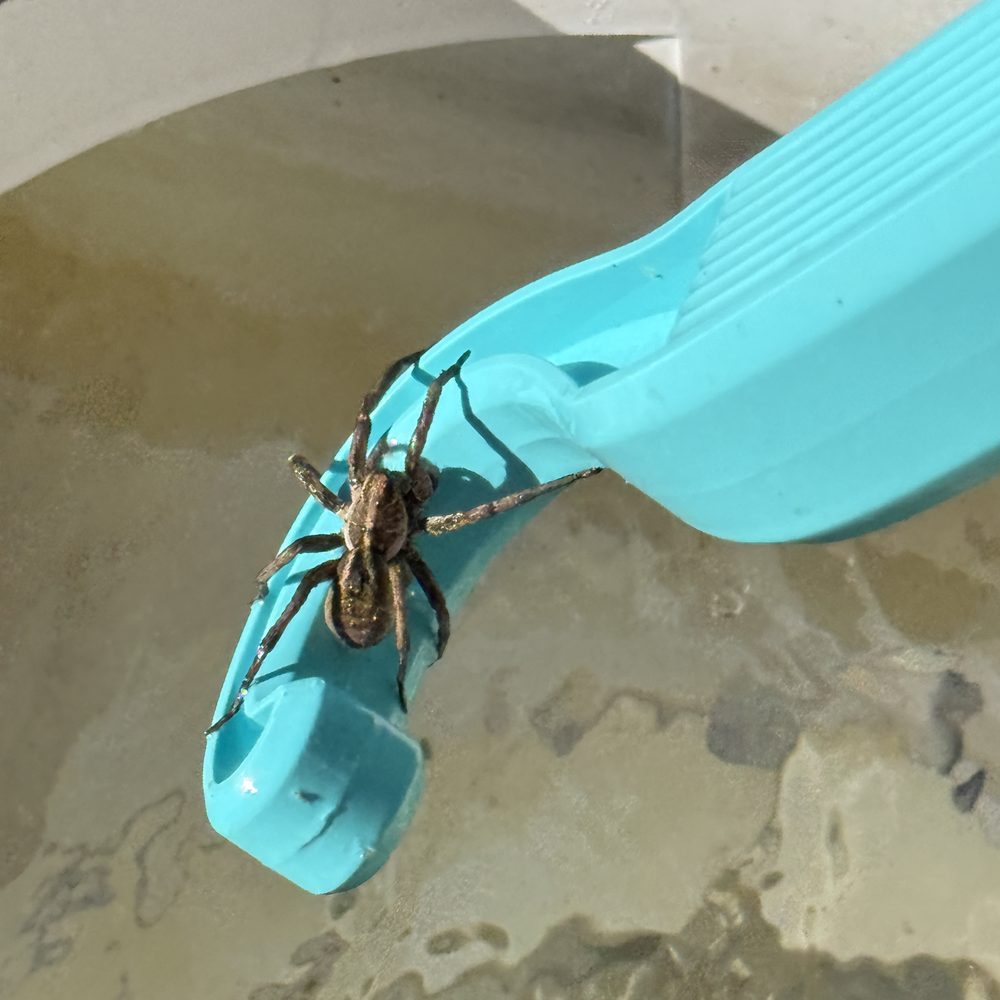
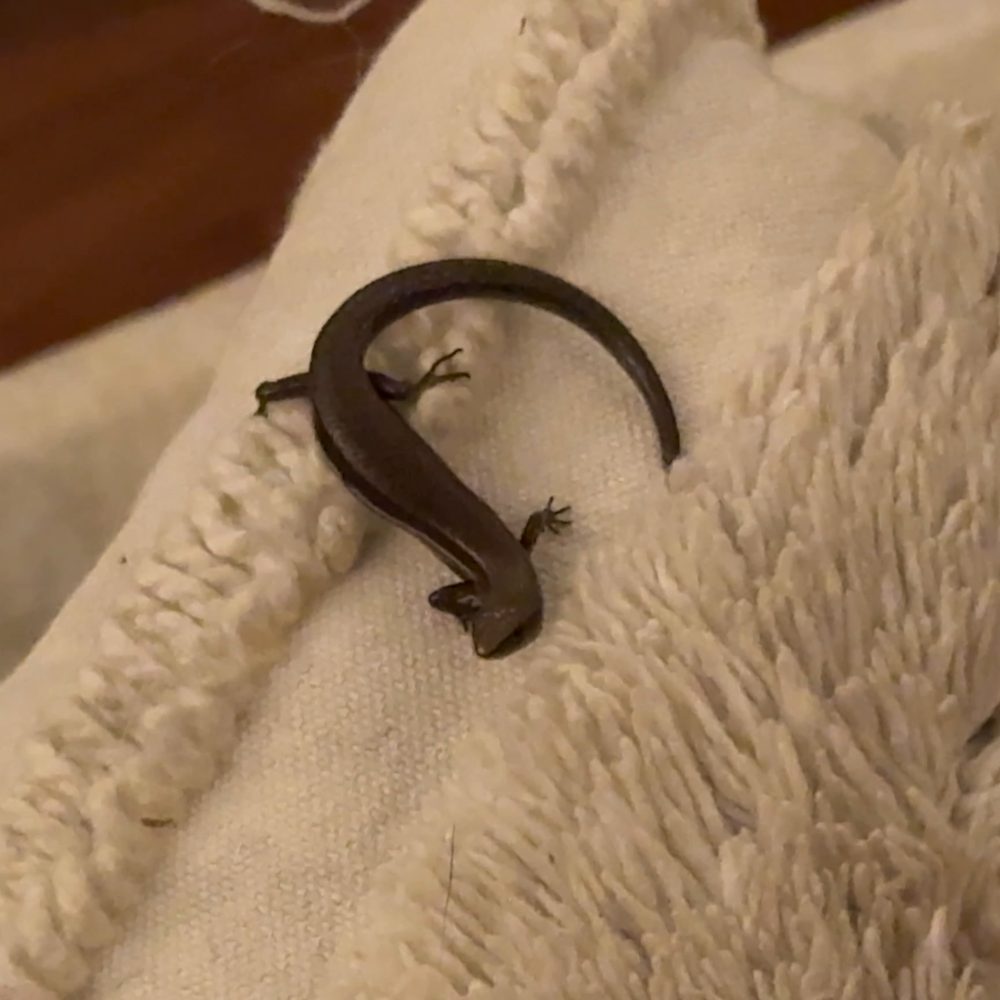
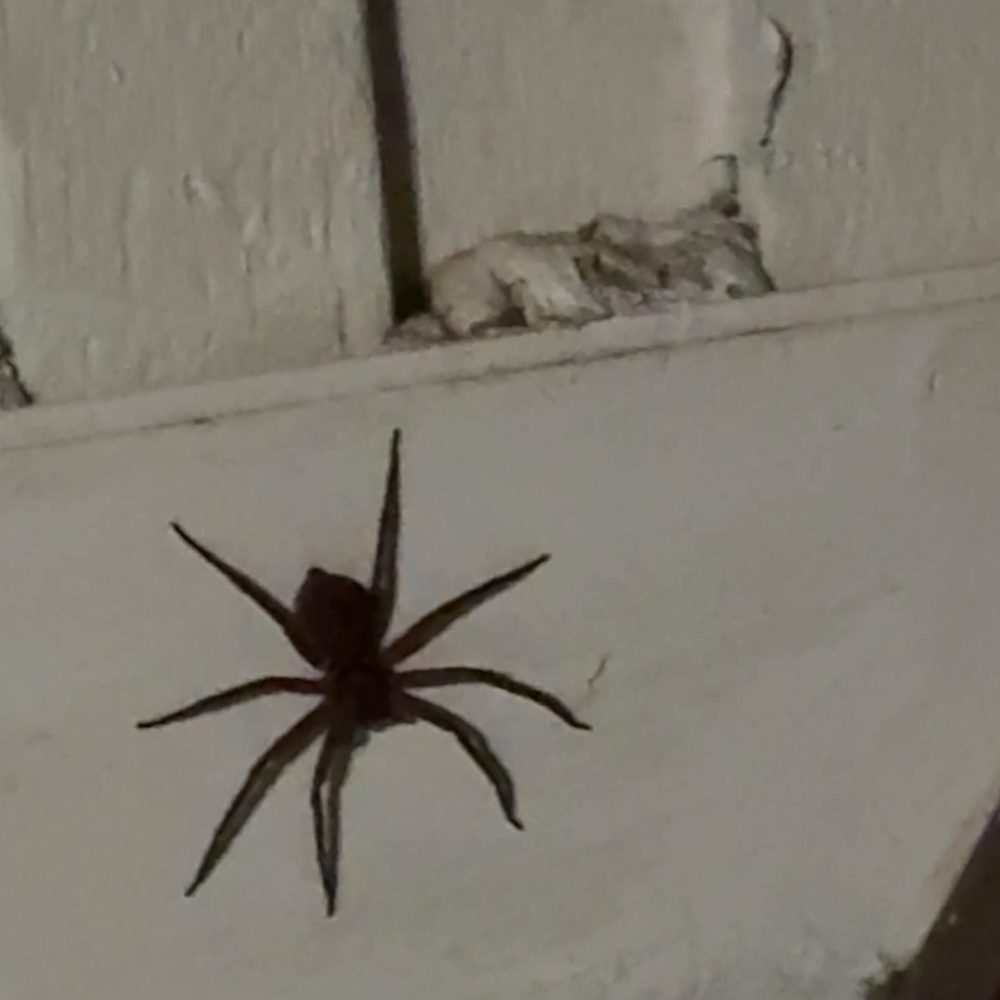
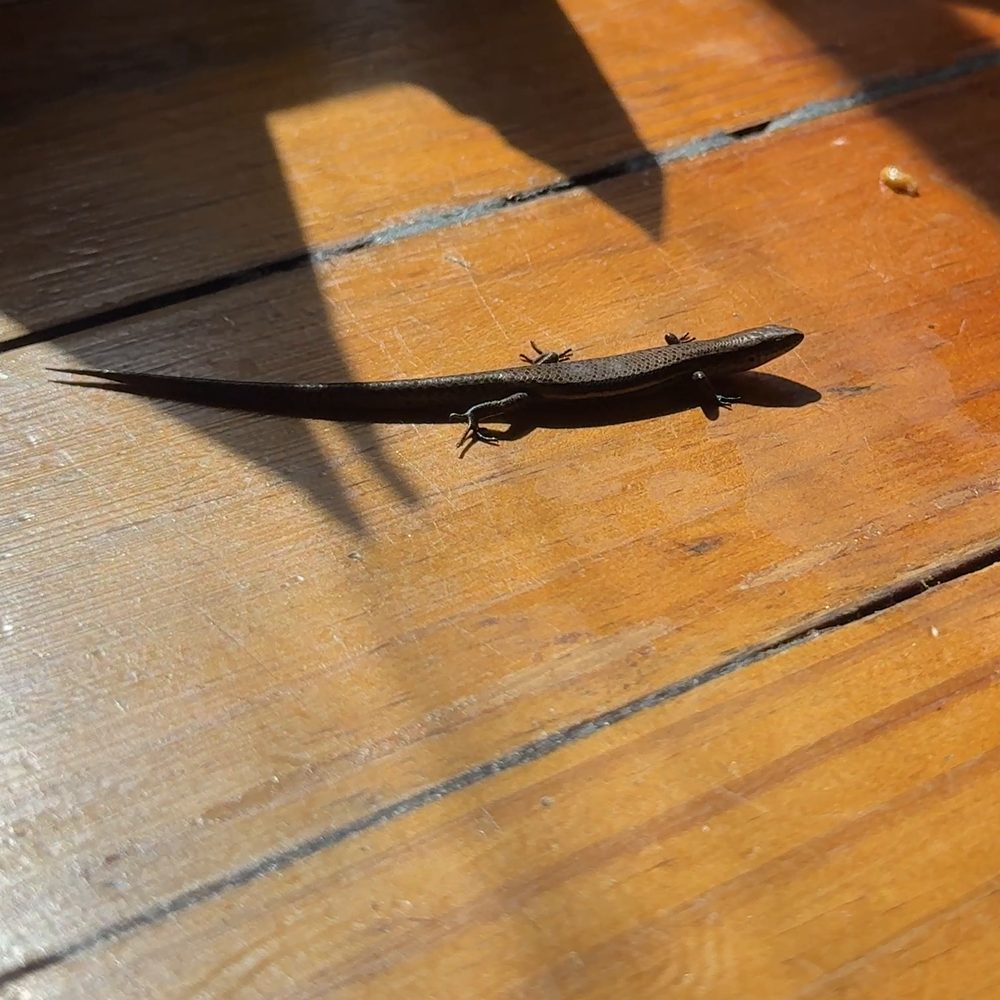
14 September, two snakes in one day
At 9:54 in the morning it was back. Same wall, same corner by the pool as eleven days earlier. A green tree snake, olive-bronze back, pale salmon flank, and we watched it for ten minutes straight as it pulled itself between the boulders and slid back under the leaves.
That is the point where something shifted for me. It is no longer an encounter. I have seen it several times now in exactly that spot. The snakes live there. They are not an event, they are neighbours. And you settle in differently once you have understood that, compared to waiting for the one dramatic moment.
At ten to four that afternoon, about ninety metres from the house, the second one was lying there. Thick, powerful, a high-contrast black and cream pattern, coiled in a crack in the rock. A python. And then came the question this whole article is really building towards, from one of the children:

Are they not dangerous at all?
The answer was: they are not venomous. No, they are not. And the answer is correct. Pythons kill by constriction, not venom. For a human the ones here are not a problem. For a chicken they are.
Lucy's side of it
I am the one with the camera, which is why this is my version. Lucy has her own, and hers is more matter-of-fact. She was out with Linnea when a very large python was lying on the road a few minutes from our future house. Her explanation was neither bad luck nor drama, it was geography: there is a river here, there is rainforest here, so there are more snakes here. Plus big cane toads and, as she puts it, properly green frogs.
The house we are moving into next has no flyscreens on the doors and windows. Lucy wants them fitted, and her reasoning is the best sentence either of us has produced on this subject:
Because I do want to know what is inside the house, and what I can expect when I walk around somewhere and clear something out.
I think we have to find the right balance here. Treat the new situation with respect and still try to let go of the fear. It will certainly take a few more months before you get used to it. We are looking forward to every single day.
What you will not find here
A large share of the fear of Australia is aimed at animals that simply do not live in our corner of it. That belongs in an honest answer.
On the east coast the saltwater crocodile occurs only as far south as roughly Gladstone and Rockhampton in Queensland. We are about a thousand kilometres further south. The cassowary lives in the Wet Tropics of north-eastern Queensland, between Cooktown and Townsville. Both are as far from here as Hamburg is from Rome.
The wombat surprised me. It sat on our list for a long time, until I looked it up. According to the Australian Museum, in northern New South Wales it lives only in sclerophyll forest above about 600 metres, and it avoids rainforest. We live in rainforest, considerably lower. It dropped off our list before we ever got to tick it.
Your list to take along
Our pass is at the top. Here is yours, still empty. Same form, different state. Sorted not by rarity, but by where you need to look.
On the water
From the headland or the beach. Binoculars help more than any app.
In forest and bush
Early morning and at dusk. Walk slowly, look up often.
Garden and house
Most encounters happen here, not out in the wild.
At night
Ears before eyes. You hear most of it long before you see it.
Your ticks are only stored in this browser. If you clear your browsing data, the list starts from zero again. Hence the print button.
Frequently asked questions
How dangerous are snakes in Australia really?
Between July 2005 and June 2015 the Australian Snakebite Project recorded 23 deaths, a median of two per year. Over the same period 1548 people were admitted with suspected snakebite, 835 of them actually envenomed. 17 of the 23 deaths were attributed to brown snakes.
How do bites happen in the first place?
In 47.1 per cent of cases the person was walking or doing something else, unknowingly near the snake. In 14 per cent they were trying to catch or kill it, and in 8.3 per cent it happened while gardening. In 52 per cent the bite was to a leg. Almost half of all cases happened in or immediately around buildings.
Are there crocodiles in Byron Bay?
No. On the east coast the saltwater crocodile occurs only as far south as roughly Gladstone and Rockhampton in Queensland, about a thousand kilometres north of here.
When can you see whales here?
Humpback whales pass along the east coast between May and November. Cape Byron, the easternmost point of the Australian mainland, sits directly on the route. We saw our first on 3 July and the best one on 26 July, right beside the surfers.
Are pythons in Australia dangerous?
Pythons are non-venomous. They kill prey not with venom but by wrapping around it and suffocating it, as the Australian Museum describes it. The species here are not life-threatening to people. A bite can still hurt and, like any bite wound, should be seen by a doctor. Keeping your distance and leaving the animal alone is entirely enough.
Should I worry more with small children?
We are here with two small children and have not had a single dangerous situation in three months, not even since we moved into the rainforest and snakes became part of the property. What has changed are habits: closed shoes in the bush, stay on the path, carry a light at night, touch nothing. It is less effort than it sounds, and after two weeks you do it automatically. We have still had one proper fright. What we talked through with the children before moving is in our guide to moving with kids.
Where these details come from: every sighting in this article is our own observation between 25 June and 14 September 2026, first around Byron Bay and since late August in the hinterland. Every single one is backed by our own video and photo material with recording dates. The snakebite figures come from theAustralian Snakebite Project (ASP-20), Medical Journal of Australia 2017. Whale season according to WWF Australia and Visit NSW, the wombat range according to theAustralian Museum, saltwater crocodile and cassowary ranges according to Australian government agencies and conservation organisations.
Last updated: 17 September 2026. Published on 3 September, extended since then by the rainforest section, two snake species, goanna, gecko and cane toad. The list keeps growing and we keep updating it.