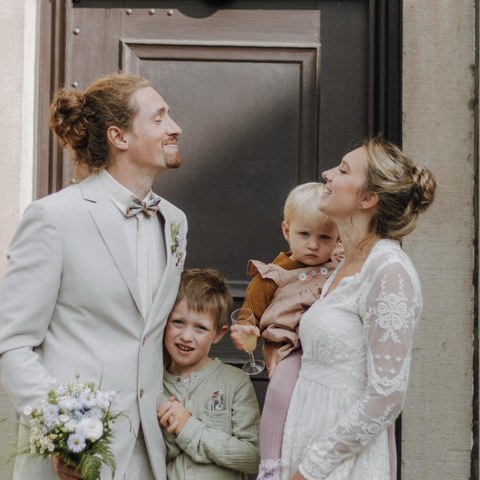
Arriving & everyday life
A family of four again: our first days together in Australia

I spent five weeks here alone. On 28 July, at eight in the morning, the plane from Dubai lands in Brisbane, carrying the three people who mean everything to me: Lucy, Joris, Linnea. This article tells the story of our first days as a family in Australia. The reunion, the traffic jam right after, the jet lag nights, the move into the house sit. With all the highs and all the lows.
Key takeaways
- The flights for Lucy and the kids cost 3,061.80 euros in total (Emirates, Düsseldorf via Dubai to Brisbane).
- Luggage trick: on our fare, 30 kg per person, split across as many pieces as you like. We packed 7 lightweight duffel bags instead of suitcases.
- Plan the arrival day generously: for us, almost two hours of accident traffic came on top of the two-hour drive to Byron Bay.
- Jet lag with kids: pushing through the first day helps, but it still took several days until everyone slept through the night.
- House sitting right after arrival takes enormous pressure off: four weeks without rent, with a house, garden and animals.
- Winter is a plus, not a minus: chilly nights, around 20 degrees in the daytime, and the kids are outside every single day.
Two screens in Brisbane
I was almost late. That morning the drive to Brisbane took me nearly three and a half hours, rush hour, heavy traffic. The whole way, the same thought kept looping: the three of them will walk out of that plane any minute, they have no Australian phone reception, and I am not there. Luckily the flight itself was delayed. It was enough.
In the arrivals area in Brisbane there are two screens above the waiting crowd showing who is currently walking out of the baggage hall towards the exit. So you can already see in advance when the people you are waiting for are about to come through the door.

I stared at the screen the whole time. And then, there they were, as a small camera image: Joris pushing the stroller with Linnea asleep inside, Lucy pushing the luggage trolley with the seven heavy duffel bags. The grin came instantly. When the three of them came around the corner in real life, the tears came too. We did not say much and simply held each other. Joris meanwhile was looking around with huge eyes, because everything was new. Linnea slept through the entire moment.
- DXB → BNE
- LANDED
- LINNEA
- ASLEEP IN THE STROLLER
- JORIS
- PUSHING THE STROLLER
- LUCY
- 7 DUFFEL BAGS ON THE TROLLEY
- CHRISTIAN
- 3.5 HOUR DRIVE · WAITING AT THE MONITOR
Why the three of them flew four weeks after me in the first place, and what five weeks alone on the other side of the world feel like, is in the article about my first days alone in Australia. The same weeks also exist in moving pictures: as the first episode of our documentary on YouTube, "Angekommen. Und es fühlt sich falsch an." (in German). The short version: those five weeks made one thing very clear to me. Life without my family is no longer fulfilling. No matter where you are and how beautiful it is.
A reunion in a traffic jam
The luggage trick first, because after this nobody thinks about logistics anymore: on our Emirates fare, every person could take 30 kilograms of luggage, split across as many pieces as you like. So we did not buy suitcases, we bought duffel bags. They weigh next to nothing and they are flexible. In the end, seven olive-green bags stood on the trolley: our entire remaining life from Germany. The flights for the three of them cost 3,061.80 euros in total. How we booked and why the price was what it was is in the article about flight costs for a family.

Then the drive home, two hours to Byron Bay. So we thought. Because of an accident, nothing moved on the highway for almost two hours. Linnea had woken up right before we hit the jam, of all moments. I had imagined that moment differently. I could not pick her up, since I was at the wheel. I caught up on it in the middle of the traffic jam, between standing cars. She was completely overtired and still incredibly happy.
Lucy was completely wrecked. She had not slept a minute on the plane, probably that subconscious tension of being solely responsible for two kids on a long-haul flight. Joris practically fell asleep standing up when we got out of the car in the jam, but he powered through because he did not want to miss anything. And so there we stood, on an Australian highway, finally a family of four again, talking about the flight and about what we wanted to do in the first days.
The first beach afternoon
At the Airbnb in Byron Bay we quickly unloaded the car, and then we went straight to the beach. It was the moment of the day, maybe of the week: both kids were suddenly wide awake the second they stood at the water. Joris ran back and forth through the shallow water like mad, Linnea jumped into the small shallow waves at the front. The tiredness of 24 hours of travelling had simply evaporated.
Simply seeing that we are doing the right thing, and that despite all the hard steps still ahead of us, we are somehow making this life here work.
That is how I described this afternoon afterwards, and I stand by it. The most important thing is that the kids live a happy and fulfilled life. On this afternoon, it looked exactly like that.

Jet lag times four: the first nights
How long does jet lag last with kids? For us: several days until everyone slept through the night again. The three of them landed in the morning, and we deliberately pushed through the day to get into the rhythm. It helped, but it was no magic trick.
Our jet lag days in detail
- Push through the day: morning arrival, no nap for the big ones, early bedtime. The classic, and it works, just not instantly.
- Early nights: for the first days, Lucy fell asleep with the kids between 6 and 7 pm. Not planned, it just happened.
- Relapses allowed: Linnea went back to daytime naps for a few days, which she normally does not do anymore. The mix of jet lag and all the new impressions was clearly exhausting, Joris was unusually tired early too.
- Early risers win: we get up early and go to bed early anyway. The Australian rhythm plays right into that. Hence the sunrise beach photos on the second morning.

Move number one: the house sit in the hinterland
The Airbnb was only ever the bridge: booked until 31 July, 765.70 euros in total for the almost ten days during which I had already lived there alone. For the three of them it was just three nights. Then the next move was due, the first as a family: out of Byron Bay, into the hinterland near Murwillumbah, into our house sit for the next four weeks.
In case the term is new to you: house sitting means looking after someone's home while they are travelling. You live there for free and in return take care of the garden, the pool or, in our case, the animals. No rent, but real responsibility.
The house is an absolute stroke of luck. Beautiful, big, well kept, in a very quiet suburb, with a property the kids can run onto straight from the front door. Four weeks without moving, without rent, with time to plan everything else. How house sitting works in detail and how we found our sits will get its own article, because it is our biggest cost lever while settling in. What life here costs overall, we track in our big cost guide.

€3,061.80
Flights for Lucy and the kids, Emirates via Dubai
7
duffel bags for our entire remaining life
2 hrs
accident traffic on the way home, barely moving
€765.70
Airbnb bridge in Byron Bay, almost ten days
Chickens, two dogs, passionfruit
The house sit comes with two dogs. Tinsel looks like a Dalmatian but is a mixed breed, nobody knows exactly what. She was shy and anxious for the first two or three days; since she thawed, she has been a wonderfully uncomplicated, sweet dog who listens to every word on walks. Hammer, the small black one, has only lived here for a few weeks himself, the owners rescued him. His hearing is not great anymore, but he is a very funny old gentleman who has zero interest in walks: he always trots a few steps down the driveway, turns around and shuffles back to the house.
The kids feed both dogs entirely on their own, roam the property with them, and Linnea especially is head over heels. Only when it comes to poo patrol does the fun stop. That remains a parent job.
House-sit life in three pictures
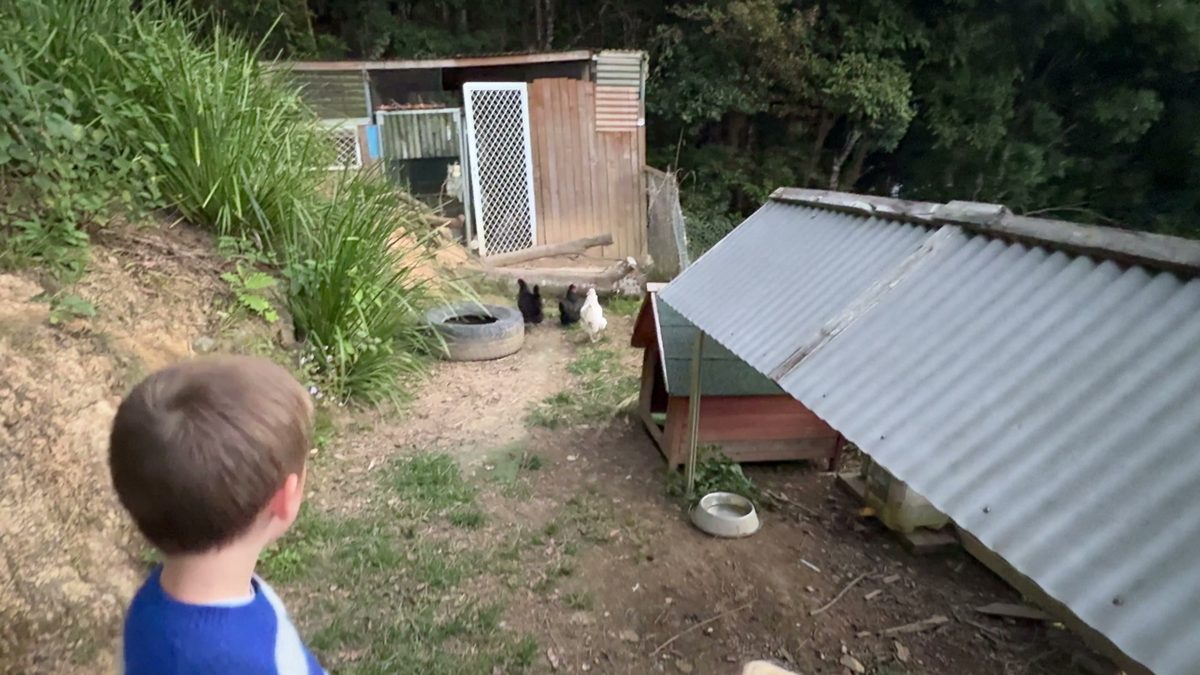
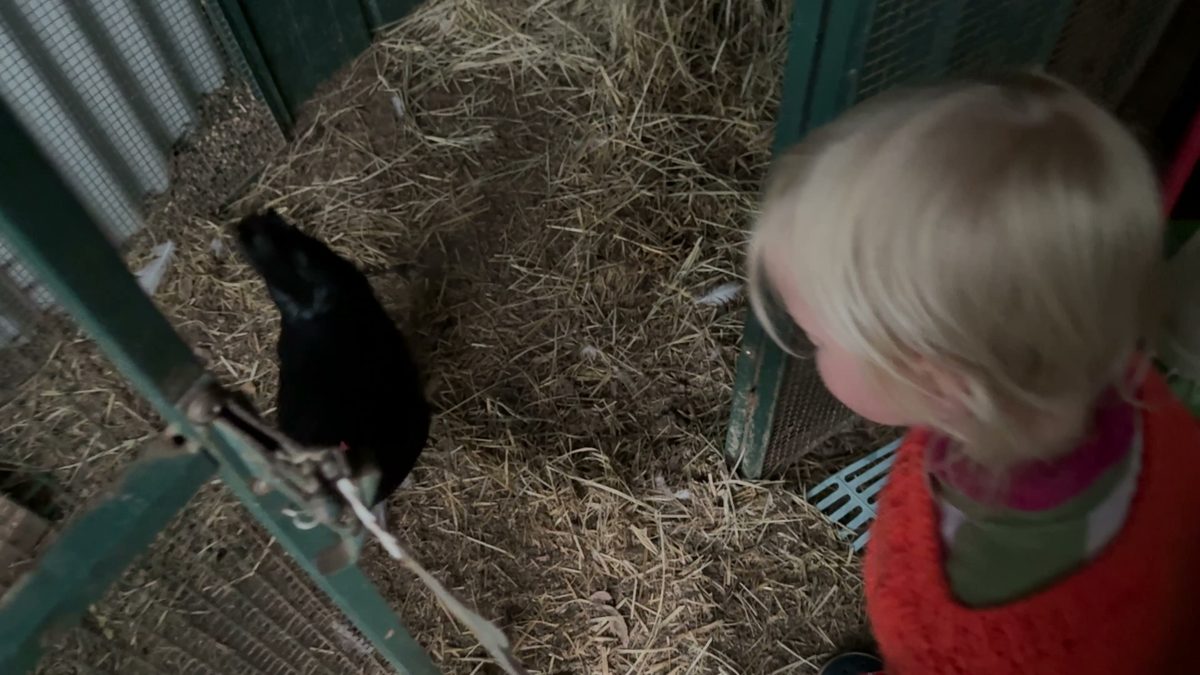
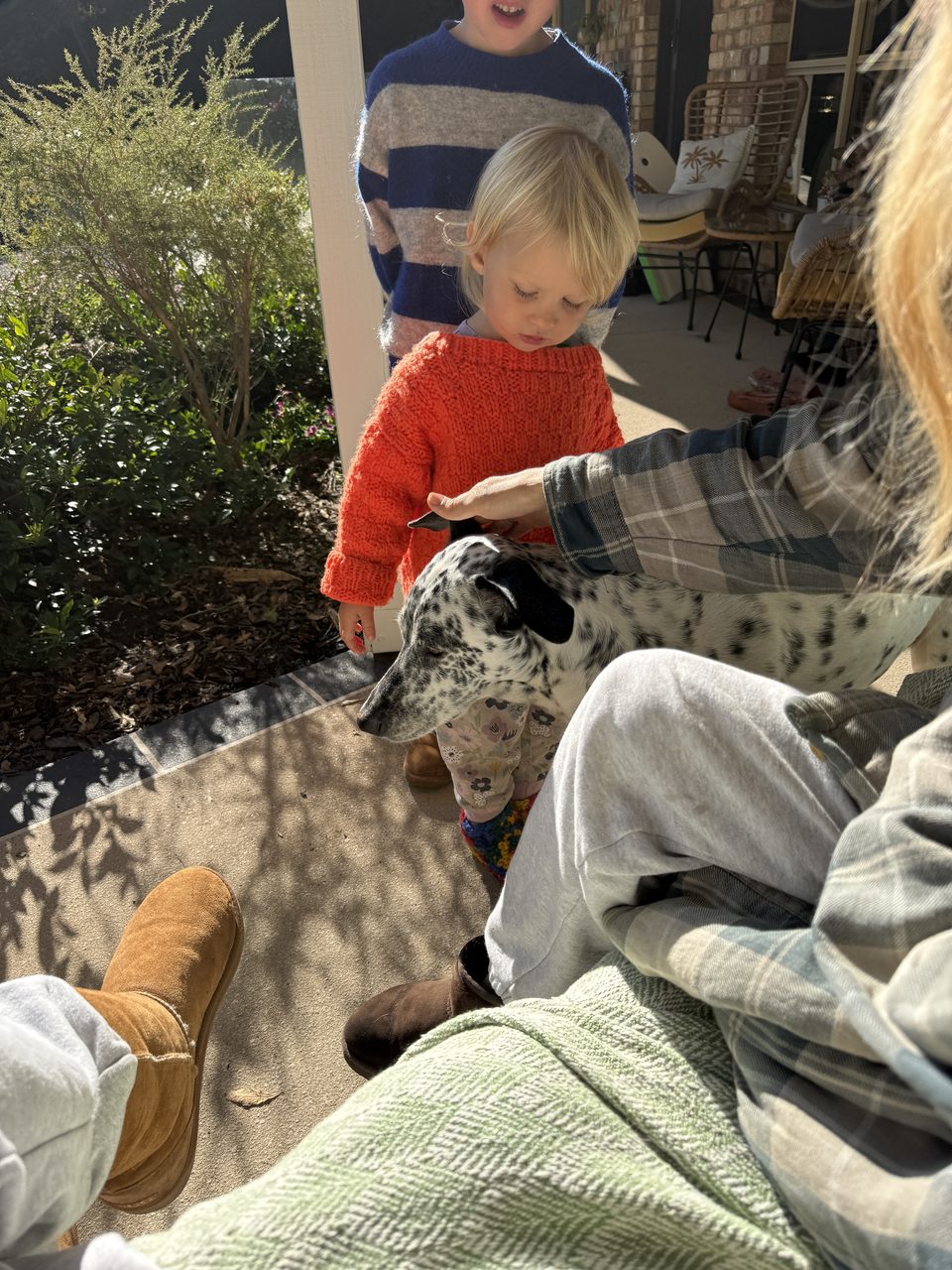
Then there are the chickens. Once a day someone checks what has been laid: sometimes three eggs, sometimes one, sometimes none, the ladies are getting on a bit. Fresh food and water every two days, and of course the kids handle that. Passionfruit grows along the fence, and the two of them are obsessed: every day they check whether ripe fruit has dropped, ready to eat on the spot.
And yes, that margin note is meant seriously: the local snake catcher in Murwillumbah regularly reports carpet pythons helping themselves to chickens. In the Australian winter, though, snakes are barely active; things only pick up again in spring. So our rule is relaxed, but it is a rule: the kids do not go into the coop alone.
Walkie-talkies and a bird drawing
Two things tell the story of our arrival better than any summary. The first: the walkie-talkies the kids brought from Germany. The typical walk with Tinsel now looks like this: I take Linnea and one walkie-talkie. Joris sits on the couch at home and radios us the whole time. We even tested whether the range covers the whole distance, and yes: the signal held the whole way. Back in Germany we had a lovely flat, but no garden. A property where kids can simply run off was always a dream of ours. Here, it is almost the default.
The second: a sheet of paper. Lucy had taken both kids and Tinsel to a small park nearby; the "playground" there consists of one swing in the middle of a huge meadow. Afterwards, Joris sat down and drew what he had seen: the birds.

In the picture: a cockatoo with a yellow crest, a brush turkey, a flying bird, plus trees and a big orange sun. Brush turkeys and cockatoos the kids can now name with confidence. And then there is their favourite: a bird that looks like it is wearing a yellow mask. The two of them find it absolutely hilarious.
Skate parks: the new family hobby
One thing we had not planned for: besides working our way through the beaches, the first days turned into a little skate park tour. We discovered that basically every town here has its own skate park, and not a sad concrete leftover, but properly good, well-kept facilities. Free, public, simply there. Joris borrowed a park scooter from the people whose house we are sitting, we are kindly allowed to use everything, helmet included. Linnea has her toy unicorn to ride around on. And Lucy and I have since bought a skateboard and are trying to teach ourselves.

The only park that was properly busy was the one in Byron Bay. And that is exactly where the most beautiful thing was on display: every age group was there. Dads with their kids, the dads mostly on skateboards themselves, teenagers, some older folks too. And nobody gets worked up about toddlers standing in the way. Simply a lovely way of sharing a space. Exactly the kind of everyday life we came here for: kids outside, movement, and a public space that carries it.


What remains after week one
What does the first week as an emigrated family feel like? The short answer: good, but we deliberately do not fully trust the peace yet. There is still a bit of holiday mood in the air, because I am not working yet and Joris is not in school yet. It is too early to say that all of this was worth it. Right now it feels like it. But that is also simply the first phase.
For Lucy, the beginning was the harder part. Everything was a lot: the new impressions, the new life, the huge responsibility, and then we also had to move again after just a few days. Her questions were the big ones: How are we going to manage all of this? What is best for the kids? It took a few days until she had properly arrived too. There was no real argument, but not everything was easy either.
The beginning is exhausting, because you cannot do anything in your usual rhythms. But it is rather beautiful when you notice, in lots of small moments, what life could be like.
Added to that is Lucy's second, quieter finding: it is lovely to see that Joris and Linnea feel so at home here, and that the move does not seem nearly as hard for them as you would have expected beforehand.
And winter? So far it is an argument for Australia, not against it. Nights get chilly, and with the poorly insulated houses here you really notice it. During the day the August mean at the coast is a 20.2 degree maximum and a 13.2 degree minimum, and the sun feels warmer here: as soon as it comes out, it feels like beach weather to us. In practice that means: fire in the wood stove in the evening or morning, beach or skate park in the afternoon. The mere fact that it is winter and we are still outside every single day is almost worth the whole thing on its own.
This is how our days end at the moment: Lucy lights the wood stove with the kids, it gets dark outside, the house smells of firewood. How things continue, with school, housing and everything still open, we will tell step by step. How this whole journey started in the first place is in our story from vegetable garden to Australia. And how we prepared the kids for all of this, in the guide to emigrating with kids.
Frequently asked questions
How long does jet lag last for kids after arriving in Australia?
For us it took several days until everyone slept through the night again. We deliberately pushed through the arrival day, but Lucy still fell asleep with the kids between 6 and 7 pm at first, and Linnea went back to daytime naps for a few days.
What did the flights to Australia cost for the family?
3,061.80 euros for Lucy and the two kids together, Emirates from Düsseldorf via Dubai to Brisbane, booked in late March 2026 via Expedia. My single flight a month earlier cost 467 euros.
How much luggage can a family take on Emirates?
On our fare it was 30 kilograms per person, split across as many pieces as you like. That is why we packed 7 lightweight duffel bags instead of suitcases. The exact allowance depends on the Emirates fare you book, worth checking before booking.
Where does a family live right after arriving in Australia?
We used an Airbnb in Byron Bay as a bridge for the first three nights (765.70 euros for the whole booking of almost ten days, during which I already lived there alone). Then we moved into a house sit in the hinterland for four weeks, which costs no rent.
How cold is winter in and around Byron Bay?
In August the mean daily maximum at the Cape Byron station is 20.2 degrees Celsius, the minimum 13.2 degrees. Nights get chilly, colder in the hinterland, while days in the sun are pleasantly warm.
How quickly do kids settle in after emigrating?
Our two were wide awake and happy the moment they reached the beach on the first afternoon. After a week both seemed settled, but the honest part belongs in the answer too: it is early days, and much of it still feels like a holiday because school and work have not started yet.
Status: August 2026. Lucy and the kids have been here since 28 July, we are living in the hinterland house sit until the end of August. How things continue with housing and school, we will tell here step by step.
Note: This post tells our personal experience of arriving in Australia as a family. It is not legal or migration advice. Airline baggage rules and fares can change; the airline's own information is always what counts. Climate data: Bureau of Meteorology, Cape Byron station (August monthly means).
Last updated: 13 August 2026
Update log