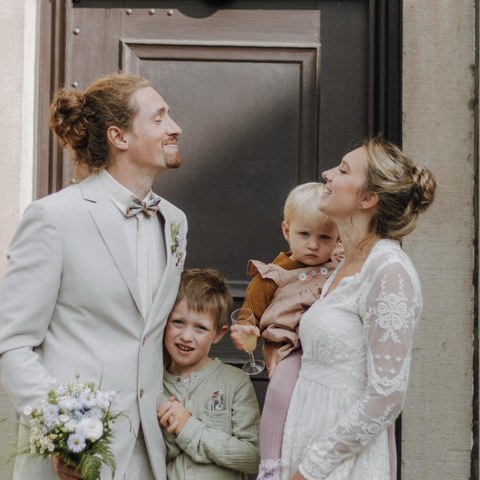
Family & Kids
Moving to Australia With Kids (2 and 6): Honest Family Prep
We are moving to Australia this summer with our two kids (6 and 2), more precisely to the Byron Bay / Northern Rivers region. This piece describes how we prepared Joris and Linnea for this big step, and how it then actually went. What worked, what was difficult, what questions a 6-year-old asks and how we deal with it. Our experience. For families planning something similar, or wondering if they'd be mad to do it.
For context
Our move in numbers
6 and 2
years old are our kids
~1 year
Joris heard about it before departure
5 weeks
Dad and kids are apart
February 2027
Joris has his first Australian school day
Why we are "putting our kids through this"
I can already hear the question: "Why are you tearing your kids out of the world they know?"
The honest answer: because we believe long term it's the right thing for them. And because we feel how much Germany is dragging us down at the moment.
That sounds harsh. It is.
For seven years I ran a restaurant. The summers were especially brutal, I was basically not at home. That affected the kids, even if they didn't say it directly. The question of whether we wanted to keep sacrificing this much family time for the restaurant became more and more pressing in the second half of 2025. Now that the restaurant is closed, I really notice what we missed.
What we hope for the kids
More connection to nature. Life in Australia happens outdoors, basically all year round. Not just at the weekend when the weather lines up, but as the default.
People around them in a better mood. We have the feeling that the mood in Germany keeps getting worse. People are often grumpy, annoyed at all kinds of things. We notice it in our everyday life, and it pulls Lucy and me down, which then carries over to the kids.
In Australia not everything is great either. Many conversations are more surface-level than here. But the base mood, especially in the region we are going to, is simply more positive.
Less worry about the future. Not only domestically, but internationally too, we see many things in Germany going downhill. Especially what it means for the kids' prospects. That may sound dramatic. But it's an honest reason.

How we introduced the topic
Our approach was: no big announcement, but slowly weaving it into everyday life.
Since Lucy and I talk about the move a lot, it became a topic all by itself. At first only when we were alone. But at some point it became present in normal family life too.
Timeline: In the end Joris heard about it for almost a year before it actually started. A gradual process instead of one big conversation.
That has pros and cons. Pro: no shock, no sudden overload. Con: the uncertainty drags on. But for us this was the right way.
Joris (6): he understands it – and that makes it complicated
Joris turns seven in November, he'll be celebrating that birthday in Australia. When we told him, his reaction was classic kid: he's happy he finally gets a summer birthday.
But it wasn't just looking forward to it.
It was a process, not a moment
There wasn't one moment where he "got it". It was more a slow realisation over weeks and months. He was looking forward to the adventure, but you could also tell something heavy was starting to sit on him.
How that showed: He became noticeably clingier. Normal things like going to kindergarten in the morning were suddenly harder, even though he actually liked it and everything used to be fine. He didn't want to be away from us as much any more.
That was exhausting. But it was also understandable. His whole little life was shifting, and he felt it.
What we showed him
We showed him lots of old photos from when we lived in Byron Bay ourselves. Plus current videos of what it looks like there. We talked about the animals, the plants, the trees.
You have to be careful not to set expectations too high. In the end we'll lead a perfectly normal life there too, with a perfectly normal everyday routine. Not every moment is an adventure. We tried to get that across to him as well.
From "Why not sooner?" to his own plan
In April, three months before departure, came the moment that showed us how far he had come. We told him it would start in three months. His answer:
Why not sooner?
The early uncertainty had turned into anticipation.
On Whit Monday, a good four weeks before departure, we talked about "in ten years". That's when he realised: in ten years we'll be living in Australia, not in Germany any more. His reaction, word for word: "Okay, that's a bit strange, but then I definitely want to call my friend a lot."
He handles the distance topic himself and actively thinks up solutions. We couldn't ask more of a 6-year-old.
The question that hit us
At some point Joris asked: "Will no one come to my birthday any more?"
That landed.
We told him that of course we'll still talk to everyone. That there will be presents from everyone. But also honestly: that we'll celebrate differently and more limited than here. In return we'll do great things together on the day, just the four of us.
No lie, no sugar-coating. But no drama either.
The questions he's been asking since
Joris asks a lot of questions. Some practical, some emotional. The three that stayed with us most you can flip over here, along with how we answered them:
Will no one come to my birthday any more?
Our answer:
We'll still talk to everyone. There will be presents from everyone. But we'll celebrate differently and more limited than here. In return we'll do great things together on the day, just the four of us.
Can Grandma and Grandpa visit us?
Our answer:
Yes, they can. And they are already planning to.
Do they have my favourite shop there?
Our answer:
Not that exact one. But similar things.
On top of that, a steady stream of questions about animals, about the ocean, about his future bedroom.
What we've learnt: honesty works better than sugar-coating. When we say "we don't quite know yet", he accepts it. Kids notice when you're putting on a show.
Linnea (2): too small to understand, still part of it
Linnea is two. She doesn't yet understand the complexity of all this. For her, what matters is that Mum, Dad and Joris are there. The rest is abstract.
Still, she was fully included. She also got shown pictures, sat in on conversations when we talked about Australia, heard it all.
Learning English: StudyCat instead of vocabulary lists
Joris has been learning English since early 2026. Not with vocabulary lists or lessons, but playfully: through a kids' learning app (we use StudyCat) and simple English sentences we dropped into the day. No pressure, no force.
What that looks like in detail, which app we use, what it costs, how we handle Linnea (2) and what really worries us about language is in a dedicated piece: Preparing Kids for English Before Moving to Australia.
School in Australia: where we stand
One question is completely missing up to this point: school.
The most important fact for us: the Australian school year only starts after summer, in late January. Joris therefore starts school in 2027, not in the middle of a school year as the new kid who doesn't speak the language yet. Until then he has half a year to settle into everyday life and pick up English.
One detail we only understood after looking it up: Term 1 in our region (NSW, Eastern Division) begins on 28 January 2027. The first days are staff development days though, when students don't attend. So the first real school day is 3 February 2027 (NSW Department of Education term dates, individual schools may vary). If you are planning from Europe, keep that in mind: half of January is still summer holidays here.
Lucy is primarily with the kids in the first months. Childcare for Linnea is not finalised yet, that's one of the things we'll sort out on the ground.
More than that we can't say about school yet, we simply have no experience with it so far. Once enrolment and the school start are done, the topic gets its own piece here.
The reactions from our environment
Reactions to our emigration were mixed. Very mixed.
What we heard a lot
- "You are taking the grandparents away from the kids."
- "This is a rushed and impulsive decision."
- "You won't manage without family."
- "You didn't involve us."
- "We always tried to make everything possible for you here. This behaviour is ungrateful."
That lands. Especially the accusation of being ungrateful.
The irony: in the end we planned this for more than a year. Rushed it definitely wasn't. But not everyone sees it that way.
What helps
Some people react differently. With understanding. Happy for us, even when they are sad.
We've asked both families to be sensitive about the topic, especially in front of Joris. Not constantly saying "you're going away soon". Sometimes that worked, sometimes not.
I told my parents about our plan honestly, but quite late, because I was afraid of their reaction. The reaction was actually better than expected. Of course they'd wish for it to be different. But they are trying to handle it positively.
What we didn't tell Joris
We didn't tell Joris: "If it doesn't work, we'll come back."
But we also didn't tell him it's a goodbye for ever.
Both would be too radical. We keep the option of coming back open for ourselves, but only if it really doesn't work, and not after a few hard months. We want to give it at least 1 to 2 years.
In front of Joris the plan looks the way it is: we want to build a life there. Full stop.
The farewell: how it really went
Up to here, everything was preparation. From here on, the journey began.
On 23 June it was time: my departure, five weeks ahead of the rest of the family. The staggered start was planned so I could arrive and sort out the first accommodation before Lucy and the kids land.
We didn't say goodbye at the airport, but at Essen central station. Tuesday morning, before Lucy took the kids to kindergarten and the childminder. We had agreed beforehand to keep the farewell as normal and low-key as possible, so the kids would cope better. No big drama at the gate, just: "We'll see each other in five weeks."
Photos taken, one long hug, that was it.
For the kids, it worked. For Lucy and me it was hard, but we didn't let each other see it.

Five weeks without Dad
How do a 6-year-old and a 2-year-old experience five weeks apart from their dad, in the middle of the stress of emigrating? Short version: better than us.
The rhythm that settled in: The kids call by video right after waking up. Shared breakfast with the phone running, them in Essen, me in Byron Bay. In the evening Lucy calls again on her own, once the kids are asleep.
Germany got a heatwave with temperatures close to 40 degrees, so the kids spent their days at Grandma's pool. Super happy and relaxed, well distracted. That made it easier for everyone, including me on the other side of the world.
And still: Joris kept asking how much longer. He crossed off the days until departure on a chalkboard with Lucy, and noticed after the first stretch that only four days were crossed off, even though it felt much longer. That chalkboard is my image of these five weeks.
And me? I had secretly expected the time alone to also be a bit of a break from the kids. The opposite was true. Falling asleep alone, waking up alone, eating alone: being on my own mostly showed me how much the three of them are my home. Beautiful and sad at the same time.
Our interim conclusion
Is it selfish to emigrate with kids?
Maybe. A bit. We are doing it for ourselves too, not only for the kids.
But we believe it's also the right thing for Joris and Linnea long term. More nature, more lightness, more shared time. Less of this heavy mood that dragged us down in Germany.
Joris will see this differently one day than we do. Maybe he'll be grateful. Maybe he'll be angry that we cut him off from his friends. Probably both, depending on the phase of his life.
What we want to pass on to him: that you can shape your life the way you imagine it. Not the way others expect it.
After five weeks alone I know more about that than I did in April: without the three of them, this is just a pretty place.
Status: 27 July 2026. I am in Byron Bay, Lucy and the kids took off on 26 July. How the arrival and the first weeks together go, we'll write down here once we have lived them.
This piece describes our personal experience. Every family is different, every child reacts differently. What works for us doesn't have to work for you. This is not a manual, it's a report.
Frequently asked questions
Why does a family with small kids move to Australia?
Three main reasons: more connection to nature (life in Australia happens outdoors), a fundamentally more positive mood in everyday life, and less worry about future prospects. We believe long term it's the right thing for Joris and Linnea, even though we admit that we are doing it for ourselves too.
How does a 6-year-old child react to the move abroad?
There wasn't one moment where the child "gets it", it was a slow realisation over weeks and months. During the preparation phase Joris became noticeably clingier, wanted to be away from us less. Later real anticipation kicked in: when we told him we'd fly in three months, he asked "Why not sooner?". What worked: honest answers instead of sugar-coating.
How do kids learn English before emigrating?
We used the StudyCat app, small mini-games, no pressure. Joris picks up the words surprisingly quickly. On top: in the car we analyse English songs, sometimes I ask questions in English using words he knows. No vocabulary drill, just using curiosity. Deeper dive: Preparing Kids for English Before Moving to Australia.
What do family and friends say about emigrating with kids?
Reactions were very mixed. Common ones: "You are taking the grandparents away from the kids", "This is a rushed decision", "You won't manage without family". Others reacted with understanding and are already planning the first visit. What helped: asking both families to be sensitive with the topic, especially in front of the kids.
When did the family fly to Australia?
Christian flew out on 23 June 2026 and landed in Brisbane on 25 June, then on to Byron Bay in the Northern Rivers region, NSW. Lucy followed with Joris (6) and Linnea (2) on 26 July 2026. The staggered departure gave Christian time to arrive and sort out the first accommodation. How we are planning the 186 visa is covered in our 186 Visa article, and the cost breakdown sits in the Cost Guide.
When does a 6-year-old start school in Australia?
The Australian school year starts in late January, after the summer holidays. In NSW (Eastern Division) Term 1 2027 begins on 28 January, but the first days are staff development days without students. The first real school day is 3 February 2027. Joris therefore starts school in 2027. Until then Lucy is primarily with the kids; childcare for Linnea (2) is not finalised yet.
Is it selfish to emigrate with kids?
Maybe, a little, we are doing it for ourselves too. But we believe it's also the right thing for the kids long term: more nature, more lightness, more shared time. The five weeks alone in Australia showed me one thing above all: how much the family is my home.
Note: This article is based on our personal experience and does not constitute legal or migration advice. For binding information, contact the relevant authorities or a qualified adviser.
Last updated: 27 July 2026
Update log