Our Story
From a Vegetable Garden to Australia: Moving as a Family
Key takeaways
- We moved to Australia as a family of four in summer 2026. I flew ahead on 23 June, Lucy and the kids landed in Brisbane on 28 July 2026.
- Restaurant die farm in Essen, lease from 1 February 2019 to 31 December 2025. The decision to emigrate was made in early September 2025, when our second field had to be cleared.
- Visa route: eVisitor 651 (free) → sponsor found on the ground → 186 Employer Nomination Scheme. My employer's nomination is currently in progress.
- Where we are now: we live in the hinterland near Murwillumbah, the search for a permanent home is on, and Joris' first Australian school day is 3 February 2027.
A week ago I stood in the arrivals hall of Brisbane airport at eight in the morning, staring at a sliding door. Behind it: Lucy with a luggage trolley full of duffel bags, Joris pushing the stroller, Linnea in it, fast asleep. We hadn't seen each other for five weeks. Up to that moment, our emigration was a plan with open ends. Since then, it is our life.
Anyone researching whether their family should move to Australia mostly finds polished travel reels and migration agencies that have never emigrated themselves. We want to do this differently. Here is the whole story: how two years in Byron Bay almost a decade ago slowly turned into a family, how a restaurant in Essen became a vegetable garden, how a cleared field in September 2025 triggered the decision, and what it was really like to give everything up, fly separately and come back together on the other side of the world. If you are weighing up whether your own family emigration project is realistic: this text is a comparison sheet, not an advert.
Status & note
Status: 5 August 2026, a good week after Lucy and the kids arrived. We keep updating this article quarterly, next when visa, housing and school start have become concrete.
We are not migration advisers. What's written here is our experience. Authority facts are linked; binding information only comes directly from the Department of Home Affairs or a registered Migration Agent.
Who we are
We are a family of four from Essen: Christian (37), Lucy (30), Joris (6) and Linnea (2). Since 28 July 2026 the four of us live in the Northern Rivers region on Australia's east coast. I am a trained chef and ran the restaurant die farm in Essen until the end of 2025. Lucy finished and passed her Master's thesis in interior architecture this summer, in the middle of the move. This story is ours, not migration advice, not a polished version, but what actually happened and keeps happening.
Joris starts school in Australia in early February 2027 and is already picking up English in play. What did he say when we told him we'd fly in three months? "Why so late?" That's his own voice. Linnea was too small to understand the scale, but she was right in the middle of it from the start, and that's a good thing.
For context: all of this we lived ourselves. We are not migration advisers, we share what we are doing, not what you should do.
How it began
Lucy and I met in 2016, a few months before I left for Australia. In January 2017 I flew to Byron Bay for my chef apprenticeship. Lucy followed in February, for a semester abroad she had organised at short notice. One semester became two. That one spontaneous gut decision is the origin of everything that follows: without Lucy's yes back then, we wouldn't exist as a couple, neither would Joris or Linnea, neither would Wildgewachsen nor this blog.
After Lucy's study time, we flew back to Germany together for a home visit. Lucy then stayed in Germany because she wanted to continue her studies. I went back to Byron Bay on my own to finish my apprenticeship. In total I lived there for almost two years; at the end of 2018, I returned to Germany for good.
What no one had on their radar: the goodbye from family, friends, and especially from Lucy at the end of the home visit was hard. Not "a bit difficult". Hard. That fed into the decision to return at the end of 2018. We knew Australia as a place to live, we knew the region, we had built a daily life there. But in the end Germany was closer: family, language, a restaurant to take over.
Who would have thought that a spontaneous yes to a semester abroad would become the line everything in our lives hangs on ten years later? Not us.
For context: all of this we lived ourselves. Departure January 2017, return at the end of 2018.
The return and the restaurant die farm
We returned to Germany at the end of 2018. The lease and business registration for the restaurant die farm in Essen followed on 1 February 2019, the first renovation work we already started in December 2018. Seven years later, on 31 December 2025, we closed the restaurant. Between those two dates lies the story from which our family, the plan to emigrate and the idea for this blog all grew.
Homesickness was one factor: for family, for a language in which you can also discuss tax forms. The other factor was concrete: we could take over a restaurant in Essen. A one-off chance we didn't want to let slip.
The restaurant sits on the Rutherhof in Essen, a complex with swing golf and football golf. We only ran the restaurant, not the whole complex. The concept was a countryside restaurant with ostrich meat as the speciality: steak, goulash, stroganoff, burgers. 60 seats inside, 60 outside. Through the games on the grounds, the restaurant was simultaneously an events venue: birthdays, company parties, weddings. One of those weddings was our own.
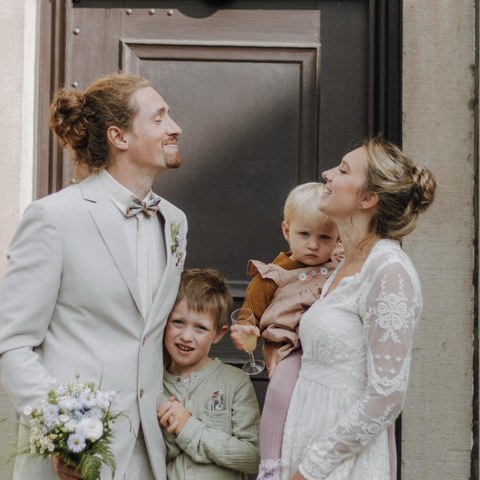
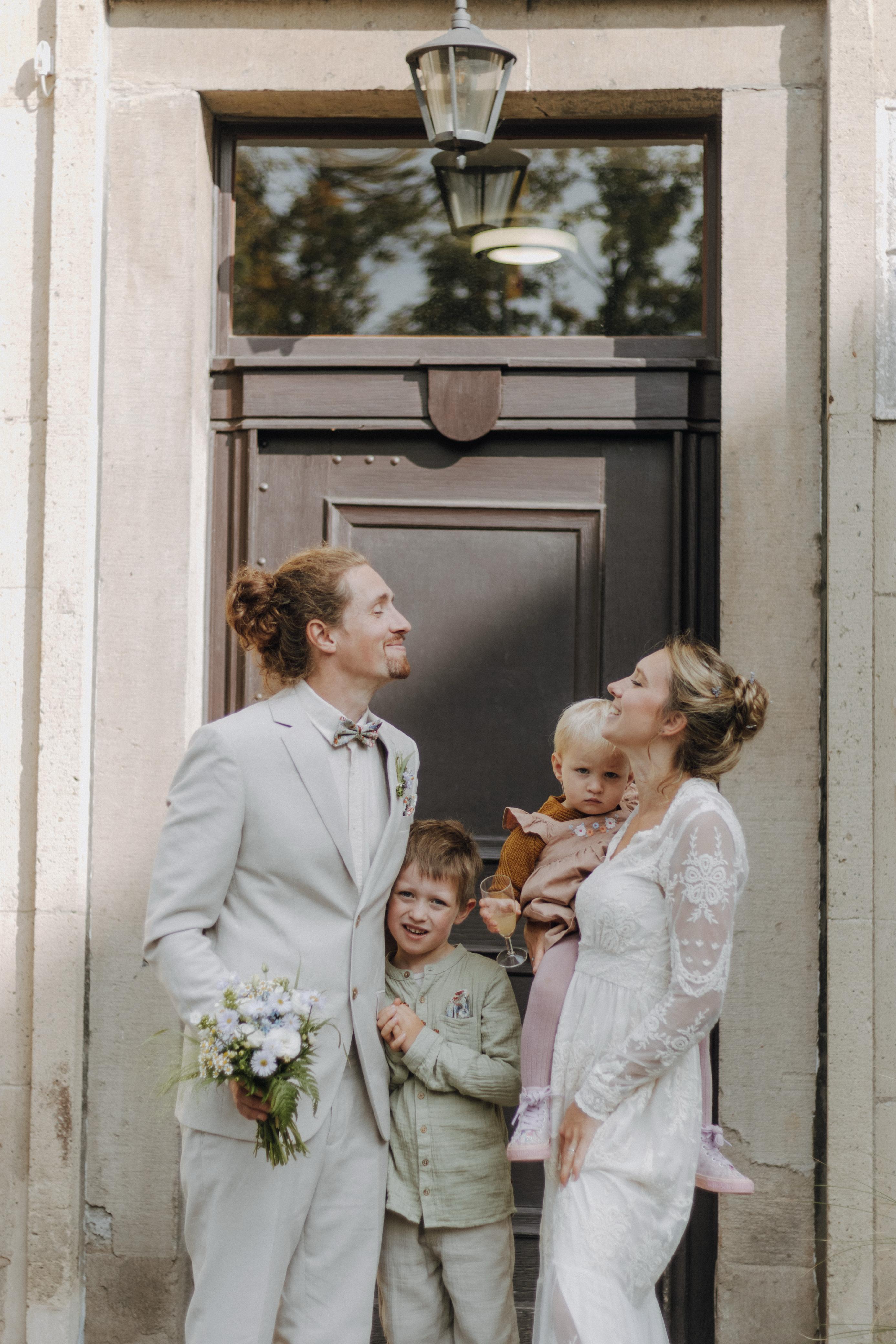
In October 2025 we got married in our own restaurant, two months before closing. The cover image of this article is from that day: Christian, Lucy, Joris and Linnea, in the place where we worked for seven years. Shortly after, we locked the doors.
In the last two years, something grew alongside it that no one had planned at the start: our own vegetable garden on the restaurant grounds. A piece of garden became proper market gardening, a hobby became a passion, and the passion became Wildgewachsen: our YouTube channel and now this blog too. Whoever follows us knows the garden more than the restaurant. That's no accident: the restaurant was the job, the garden was what we would have done even without pay.
We had a good team that had worked together for years, and in hospitality that is not a given. We didn't stop because something had broken. We stopped because we wanted to move to Australia.
For context: all of this we lived ourselves. Restaurant closed on 31 December 2025.
The moment of decision
The honest answer to "when did you decide": early September 2025, and the trigger was a field.
For years, Australia was a kind of pipe dream for us. A fondly remembered chapter of life and the recurring thought of experiencing it with the kids one day, but without serious ambition. Every time the idea came up, it failed at the same point: family and friends are here. It wasn't a dream we worked towards. It was a "someday" that never quite went away.
In parallel, another question was running in the background, and it grew more pressing in the second half of 2025: how much longer do we want to sacrifice this much family time for the restaurant? Too much work, too little time with the kids, especially in the summer months when I was basically never home.
In early September 2025 came the push that shoved both together: our second vegetable field, where we grew food for our family and for the restaurant, had to be cleared. Again. Again a lot of work that wasn't rewarded, again a plan that didn't work out. At exactly that point the restaurant doubts and the old Australia idea ran into each other, and "someday" became a joint decision: now or never. The decision to give up the restaurant and the decision to emigrate were made together. Not one after the other.
This moment exists as a video (in German): "Unser Feld ist weg. Schon wieder." on our YouTube channelThat the timing objectively made sense is something we only sorted out afterwards. Three things came together at once: Lucy was approaching her Master's. Joris was a year and a half away from school, exactly the window in which a school move abroad is easiest: he starts school over there instead of switching out of a German school halfway through. Linnea was small enough that she wouldn't cling to Germany. If not now, then not for another ten years, and I'd be 47 by then, Joris 16. My job, Lucy's degree, Joris' start at school: three upheavals, one window.
We didn't decide logically. There was no spreadsheet in which "pro Australia" won. There were many evening conversations and, at one point, a shared clarity: if not now, then never. That clarity hasn't faded since, not even in the hardest weeks.
For context: all of this we lived ourselves. A gut decision with a very concrete trigger.
Why Australia – and why now
Australia was not a researched wish for us, we knew the region. Two years in Byron Bay are not a backpacking trip, they are lived daily life with bureaucracy, housing, laundry. "Why now" had three layers: the family one (Master's, school entry, Linnea's age), the professional one (I'd had enough of the restaurant, Lucy had a concrete direction with her interior architecture in a region full of interesting building projects) and the timing one (every extra year in Germany would have made the school switch harder for Joris).
On where to live, we were realistic from the start: Byron Bay itself, the expensive inner-suburb wish, was not guaranteed with two kids and no fixed job. Mullumbimby was the favourite on paper, the criterion: 35 to 40 minutes between home and workplace, no further. As of today we actually live in exactly that area, in the hinterland near Murwillumbah, and are looking for our first proper home within exactly that radius. We never committed to one single town, we committed to this region.
What we were looking for in Australia: more family time without shift culture. A climate you feel as a gift, not a burden. A work culture in which being a chef doesn't mean not seeing my own child for three weekends in a row in summer.
For context: we know the region from two years in Byron Bay. The first place to live was an estimate, since overtaken by reality.
How we prepared
Between the decision in September 2025 and my departure lay barely ten months. By early May 2026 we had ticked off most of the pre-bureaucracy steps: visa strategy (186 Employer Nomination Scheme), PTE Academic passed, Skill Assessment as a cook completed, migration agent engaged. Then came the entry visas, and after that everything moved faster than the mountain had felt beforehand.
The complete tick-off list in detail
- Visa strategy: the goal is the 186 visa (Employer Nomination Scheme). That requires a sponsoring employer in Australia; we found one, as planned, on the ground.
- PTE Academic: sat on 11 March 2026 in Hamburg with Pearson PTE, cost 270 €. Overall score 89, classified as Proficient (+10 EOI points). Clearly enough for 186 Direct Entry. Reading 66 and Writing 75 were below the Superior threshold (70/85); if we need +20 EOI points as a safety net, we'll retake the test in Australia.
- Skill Assessment as a cook: completed through Trades Recognition Australia (TRA). Laborious and expensive, especially the documentation as a self-employed person. The item that cost us the most nerves.
- Migration agent: we work with Johannes Kunz of JK Migrate, the most frequent recommendation in the German "Auswandern nach Australien" Facebook group. We had done little research of our own beforehand and were close to dropping the whole project over the visa complexity. The paid first consultation took the fear away: he explained the visa routes we didn't know and gave us a concrete step list. In hindsight a very good decision.
- Restaurant closed on 31 December 2025.
- Flat notice given, moving out end of July 2026, follow-up tenants found, taking over the kitchen.
- eVisitor 651: issued on 28 May 2026 for all four of us, free, entirely online via my old ImmiAccount from my apprenticeship days. All four confirmations arrived within seconds by email. The eVisitor is valid for 12 months, with a maximum stay of 3 months per entry.
- Flights booked: Christian 23 June 2026 (China Southern via Guangzhou, 467 €), Lucy + kids 26 July 2026 (Emirates via Dubai).
One update belongs here because it costs money: when we wrote this article in May, the 186 application fees for the four of us were around 9,825 AUD. On 1 July 2026 they were raised: roughly 12,280 AUD for two adults and two children (main applicant 6,140 AUD). Whoever could lodge before the cut-off paid the old fee; ours wasn't ready yet. That's how honestly you have to budget: between planning and lodging, the fees can rise.
The flat clear-out was the tougher part: wardrobes, kids' things, furniture. What didn't fit in the plane went into our crate system: numbered boxes, precisely documented, stored at Lucy's father's place, shipped to Australia on demand. The estimate: around 110 € per 10 kg box, around 170 € per 20 kg box (quotes we had, final price varies). A container service was not in the running for our volume; too expensive.
If you're interested in the full costs, what was paid, estimated and planned: everything is broken down in our cost article Cost of Moving to Australia as a Family: Our Real Numbers. The detailed 186 visa route as a family is described here: 186 Visa Australia: Our Family Route to the Employer Sponsored Visa. And the Skill Assessment as a self-employed chef with all its documentation pitfalls is here: TRA Skill Assessment as a Chef.
For context: every step done ourselves. Visa fees and conditions change all the time, binding information directly from the Department of Home Affairs.
What it means to give it all up
May 2026 was not relaxed. We were both stressed, many fronts at once, all roughly equally heavy. Lucy was writing her Master's thesis full-time, with a self-imposed deadline: 23 June, my departure. Officially the submission would have been mid-July, but realistically that wasn't going to work: as soon as I was gone, Lucy was alone with two kids and the rest of the flat. Her professor backed the pace, tight it was anyway.
During the day I researched between childcare, which often fell through, and renovation work in the flat; in the evenings I wrote the blog, edited videos, worked through housesitting portals and Facebook groups. And at some point the realisation set in that in Australia a huge amount would hang on me at once: without a job no sponsor, without a sponsor no visa, without a visa no bringing the family over. That chain was what kept me awake at night.
Sorting out the flat, we had a clear division: I would have separated more radically, stored less. Lucy spent years lovingly sourcing the kids' things at flea markets; each piece a conscious choice. With the kids' things, I gave my opinion and left Lucy the decision. That was fair, because she chose those things back then and knows what she wants to keep as memories for the kids.
There was one moment in those weeks that stuck with me: cycling with the kids, when it hit me that the bikes would stay behind. A cargo bike and e-bikes with their batteries are practically impossible to ship. We cycled almost daily. Small losses like that gave the departure more weight than any big paperwork.
In that phase we talked more about the project and the planning than about ourselves. We knew it, and we held on, because it was a baseline with an end date. It was exhausting, sometimes sad, sometimes simply loud.
Three days before my departure came an evening we hadn't planned this way: the wedding of one of my closest friends. It became, quite incidentally, the goodbye to my circle of friends and our last celebration together as a family in Germany. All four of us dressed up once more, warm evening light, and the suitcases already in our heads.

For context: lived ourselves, the most exhausting phase of the whole project.
The goodbye and the flight
We said goodbye on 23 June at Essen central station, on a Tuesday morning, before Lucy took the kids to kindergarten and the childminder. We had deliberately agreed on this beforehand: as normal and unexcited as possible, so the kids would cope well. "We'll see each other in five weeks." Photos taken, one long hug, done. It worked. For Lucy and me it was hard anyway, we just didn't let it show.

One thing I would do differently today, and it definitely belongs in this article: I should have taken more time for the goodbyes. Especially the goodbye to my own parents was far too short in the stress of the final weeks, and that caught up with me in the first days in Australia more than anything else. If you are facing the same step: plan the goodbyes like an appointment. They matter more than the last box.
The flight itself was the best of my four Australia flights so far: China Southern via Guangzhou, with a night in the airline's hotel, seven hours of sleep, a shower, a big bed. In Guangzhou I sent the kids one more video message before their evening and my second flight coincided:
When you go to bed in a moment, I'll be on the plane. That means we can't call each other. But I still wanted to say good night once. And to say beep, beep, beep. We can talk tomorrow, when I have arrived. Take good care of Mum.

On 25 June at 8:30 am local time I landed in Brisbane, unusually quickly through immigration, by ten I was sitting in the rental car. "The suitcase is here, now out to the rental car. I am in Australia." That was all I managed to say into the camera in that moment.
The two-hour drive to Byron Bay I then cried through almost entirely. It was a highly emotional drive, the first time in months with room to think: "At first it was really sad, because there are so many things we simply won't experience for a very long time, or maybe forever." And then, from about Byron onwards, tears from the exact opposite: what we had worked towards for six months was coming true right there. The first thing I did at the beach: boots off.

For context: all of this we lived ourselves. The complete first week alone, with all its ups and downs, has its own article: Arrived in Australia: My First Days Alone.
Five weeks alone in Byron Bay
The mission for the five weeks was clear: sponsor, car, accommodation. That was the order on paper; in reality everything ran at once.
Accommodation: the first nights a basic room found via Facebook, 300 AUD a week, not well kept, but a roof. From 2 July the first housesit: three weeks in a beautiful house with two dogs, hidden in the rainforest hinterland near Mullumbimby. Then an Airbnb in Byron Bay as a bridge, deliberately booked so something solid would be in place when the family arrived. Housesitting saved our start; from Germany we had collected nothing but rejections for months, on the ground that flipped.
Car: in week two we bought an old Jeep Grand Cherokee for 4,500 AUD, our ceiling was 5,000. How buying a used car in New South Wales works in detail, with rego, stamp duty and all costs, is in its own article: Buying a Car in Australia.
Sponsor: at the German expat meetup in Byron Bay, a few days after arriving, I was given the line that turned out to be completely right: walk around, be open, talk to people, hospitality is always hiring. That's exactly how it went. I walked into restaurants in person, introduced myself and was open about my visa status. In the end we found each other with Threeways of the Valley, a cafe-restaurant in the middle of the Byron Bay hinterland rainforest. We sat together over many evenings talking about plans and visions, and it fit on both sides. The team there is now working on their part of my 186 application: the nomination. Once it's through, I lodge my own application with Johannes' help.
And in between: the everyday life of a long-distance family. Joris and Linnea called every morning when they woke up, we had breakfast together with the phone propped up, in the evening Lucy called once more on her own. Meanwhile a heatwave in Germany kept the kids at grandma's pool while Lucy carried thesis, the remains of the flat and solo parenting all at once. That month was harder for her than for me, and that belongs here just as much.
For context: all of this we lived ourselves. On the sponsor process: only a granted visa is binding; we describe the status, not a success that doesn't exist yet.
The family lands
On 28 July, shortly after eight in the morning, the sliding door in Brisbane opened, 35 days after the goodbye at Essen central station. Joris pushed the stroller, in it Linnea, who simply slept through the big moment. Lucy behind them with a luggage trolley stacked with olive-green duffel bags: the whole life of four people, pressed into checked luggage. We hugged each other so tightly. What you say in a moment like that, I don't remember; it wasn't much.

Welcome to Australia: after that we stood in traffic for two hours. The kids took it better than we did. Arrived in Byron Bay, we briefly dropped the bags at the Airbnb, and then we did the only right thing: we went straight to the beach. First family afternoon at the Pacific, Linnea sorting finds out of the sand, Joris chasing the outgoing wave.
The following evening, the photo was taken that we had been working towards for six months without knowing it: our first family selfie in Australia.

For context: all of this we lived ourselves. Family arrival: 28 July 2026, around 8 am local time, Brisbane.
Where we stand now
As of 5 August 2026: since 31 July we have been living in a housesit in the hinterland near Murwillumbah for four weeks. A large, well-kept property, two easy-going dogs, chickens, a wood stove for the winter evenings. The kids can simply walk out the front door and play. For arriving, this house is a stroke of luck: four weeks without moving, four weeks to plan everything else.
As I write this paragraph, Lucy is in the kitchen and the kids are out on the property with their walkie-talkies, reporting in between what they are up to. It is so good to see them move freely and play outside together. Back home we had a lovely flat, but no garden; a property like this is the exception in Germany, here it is almost standard as long as you don't live in the middle of a big city. The vegetable garden this story started with, we still miss. But the kids are growing up right now exactly the way we hoped this country would let them.
Yesterday we were in Murwillumbah, the small town nearby. School classes outside everywhere: bike training, skate lessons, basketball, kids in shorts in the middle of the Australian winter, everyone moving. That is exactly one of the things we find so good here. And the birds have their own fan now: after a walk, Joris sat down and drew all the birds he had seen, from the cockatoo to the brush turkey.

What is still open, in all honesty:
- Visa: the nomination sits with my future employer, the one part of the process we don't hold in our own hands. After that comes my own 186 application with Johannes.
- Housing: the search is on. We viewed a lovely cabin in Mullumbimby and didn't get it. An option near my future workplace is in sight, but nothing is fixed. Without a permanent job the housing market here is tough; we knew that beforehand, and it still feels different once you're in it.
- School and childcare: Joris' first school day is 3 February 2027, which school depends on where we live. Linnea's childcare is still open. Until then Lucy is primarily with the kids and reactivating her architecture contacts from the Byron Bay days in parallel.
- Car: the Jeep needs repairs before the next rego, estimated 1,000 to 1,500 AUD. We'll tackle that in the coming weeks.
For Lucy, the start was the harder one: the first days were too much at once, especially with the kids, and that weighed on her mood. Understandably. Making decisions about the future is hard when nothing that was self-evident at home is self-evident here yet. The beginning is exhausting because you can't do anything in your usual rhythms. And still, in many small moments, we notice what life here could be like. It is good to see that Joris and Linnea feel this much at home, and that all of it is less hard than we expected beforehand. The kids are content because they are here with us.
For context: lived ourselves, as of 5 August 2026. More articles on everyday life will follow once moments have turned into experience.
Would we do it again?
The question behind all questions, in every search statistic on emigrating too: do you regret it? The answer, one week into being four again: it is too early for a verdict. But right now we have a very good feeling. It feels right.
We'll say what carries that feeling at the moment: we are basically on holiday right now. I still have time off, Joris isn't in school yet, we do something every day. The everyday life that really decides "regret or not" is still ahead. But one point is already no holiday effect: it is winter, and we are outside every day anyway. Nights get cold, days are pleasantly warm as soon as the sun comes out. That alone is almost worth the whole thing for us, because it is exactly the lifestyle we came here for.
The other side remains: the distance to our families is hard. Daily video calls make it okay, but hard it stays. And the risk hasn't gone: no permanent visa, the nomination not in our hands, three to four months of financial runway, Lucy can't work full-time yet, I have to work as a chef for the first two years for visa reasons. If it doesn't work out, we fly back. That has been part of the plan from the start, financially and mentally, and that hasn't changed. It is not a recommendation, it is our deliberate bet, with the advantage that we knew the region.
This is our path. We share it on YouTube, Instagram and this blog, not to produce travel inspiration, but so families facing the same decision find real numbers and real stories instead of polished influencer versions. If that interests you, read along. We keep writing, now from the other side of the world.
For scale
Our way in numbers
35 days
lay between the goodbye and the reunion
4,500 AUD
is what our Jeep Grand Cherokee cost
12,280 AUD
are the 186 application fees for the four of us since July 2026
2 + 1
housesits and one Airbnb carried our start
Fact matrix at a glance
| Key fact | Value | Source / classification |
|---|---|---|
| Family | 4 people, Christian (37), Lucy (30), Joris (6), Linnea (2) | lived ourselves |
| First Australia years | Christian from January 2017, Lucy from February 2017 – end of 2018 | lived ourselves |
| Restaurant lease | 1 February 2019 – 31 December 2025 | lived ourselves |
| Our wedding in the restaurant | October 2025 (cover image of this article) | lived ourselves |
| Decision to emigrate | Early September 2025, trigger: clearing of the second field | lived ourselves |
| PTE Academic English test | 11 March 2026, Berlitz Hamburg, 270 €, score 89 (Proficient) | lived ourselves · source: Pearson PTE |
| Skill Assessment as a cook | Completed via Trades Recognition Australia | lived ourselves · source: TRA |
| Migration agent | Johannes Kunz, JK Migrate | lived ourselves, recommendation |
| Entry visa | eVisitor 651 for all 4, issued 28 May 2026, free, 12 months, 3 months per entry | lived ourselves · source: DHA eVisitor |
| Visa goal + status | 186 (Employer Nomination Scheme), employer's nomination in progress | lived ourselves · source: DHA Visa 186 |
| 186 application fees (2 adults + 2 kids) | roughly 12,280 AUD since 1 July 2026 (previously roughly 9,825 AUD) | source: DHA visa pricing, as of 4 August 2026 |
| Christian: departure / landing | 23 June / 25 June 2026, 8:30 am, Brisbane | lived ourselves |
| Lucy + kids: landing | 28 July 2026, around 8:00 am, Brisbane | lived ourselves |
| Car | Jeep Grand Cherokee, 4,500 AUD (+ upcoming repairs 1,000–1,500 AUD) | lived ourselves |
| Accommodation so far | Room → housesit (2–19 July) → Airbnb → family housesit (31 July–28 August) | lived ourselves |
| Joris, school start AU | first school day 3 February 2027 (NSW Term 1) | source: education.nsw.gov.au |
| Financial runway | 3 to 4 months without income | our own estimate |
| Shipping boxes | 10 kg ≈ 110 € · 20 kg ≈ 170 € | lived ourselves (quotes May 2026) |
Frequently asked questions
Why are you moving to Australia?
In January 2017 I flew to Byron Bay for my chef apprenticeship, Lucy followed in February for her semester abroad. One semester became two, almost two years in the region in which we felt at home. Since returning to Germany at the end of 2018 the wish to go back never fully went away, but for years it stayed a pipe dream without serious ambition. In 2026, Lucy's Master's degree, Joris starting school and our restaurant fatigue all lined up at the same point.
What was the concrete trigger for the decision?
In early September 2025 we had to clear our second vegetable field. Again a lot of work that wasn't rewarded, again a plan that didn't work out. In that moment the doubts about the restaurant and the old Australia idea flowed together: now or never. The decision to close the restaurant and the decision to emigrate were made together, not one after the other.
When did you close die farm?
We ran die farm, our restaurant in Essen, from 1 February 2019 to 31 December 2025, almost seven years. In October 2025 we celebrated our own wedding there, two months before closing. Our team was loyal and well-rehearsed, staff shortages were not a closure factor. Emigration was.
How did you find a sponsoring employer as a chef in Australia?
Not online, but on the ground. The tip from the German expat meetup in Byron Bay: walk around, be open, talk to people, hospitality is always hiring. That's exactly how it went. I walked into restaurants in person and introduced myself. In the end we found each other with Threeways of the Valley, a cafe-restaurant in the Byron Bay hinterland rainforest. After many evenings talking about plans and visions, the team there is now working on their part of my 186 application, the nomination.
Why did Christian fly alone first?
I flew ahead on 23 June 2026, Lucy and the kids landed in Brisbane on 28 July. In the five weeks in between I sorted sponsor, car and accommodation: a job perspective with a sponsorship commitment, a Jeep for 4,500 AUD, two housesits and an Airbnb as a bridge. When the three of them arrived, the frame was in place. That was exactly the plan, and it worked.
What does it cost to move to Australia as a family?
By early May 2026 we had spent around 6,900 € on preparation in Germany, the biggest item being the family flights. The 186 visa application fees for four people were raised on 1 July 2026 to roughly 12,280 AUD (previously roughly 9,825 AUD). For the start in Australia we had a 30,000 AUD reserve. The full breakdown, paid and estimated, is in our cost article: Cost of Moving to Australia as a Family.
Do you regret emigrating?
One week into being a family of four here, it is too early for that question. Right now we have a very good feeling, it feels right. We are honest about it: this is not everyday life yet, it feels more like a holiday. The distance to our families in Germany is hard, daily video calls make it okay. If the visa doesn't work out, we fly back, that has been part of the plan from the start.
Which visa are you using, and what is the status?
We all entered on the free eVisitor (subclass 651). The goal is the permanent 186 visa (Employer Nomination Scheme). It is a two-stage process: first the employer lodges the nomination, then I lodge my visa application, supported by Johannes Kunz. The nomination is currently in progress. After the 186 application the whole family receives a bridging visa; the eVisitor carries no no-further-stay condition. We describe the whole route here: 186 Visa Australia.
Note: This article describes our personal story, last updated on 5 August 2026, one week after the whole family arrived. It is not migration, financial or life advice and does not replace consultation with a registered Migration Agent or other professionals. Visa fees, exchange rates, job market and rental prices change all the time, binding information only comes directly from the relevant authorities.
Last updated: 5 August 2026 · Update: We update this article quarterly, next when visa, housing and school start have become concrete.
Sources:Department of Home Affairs – Visa 186,Department of Home Affairs – eVisitor 651,NSW Department of Education – Term Dates,Trades Recognition Australia (TRA),Pearson PTE Academic,Johannes Kunz – JK Migrate
Update log